
We Didn’t Have A Pitch Deck
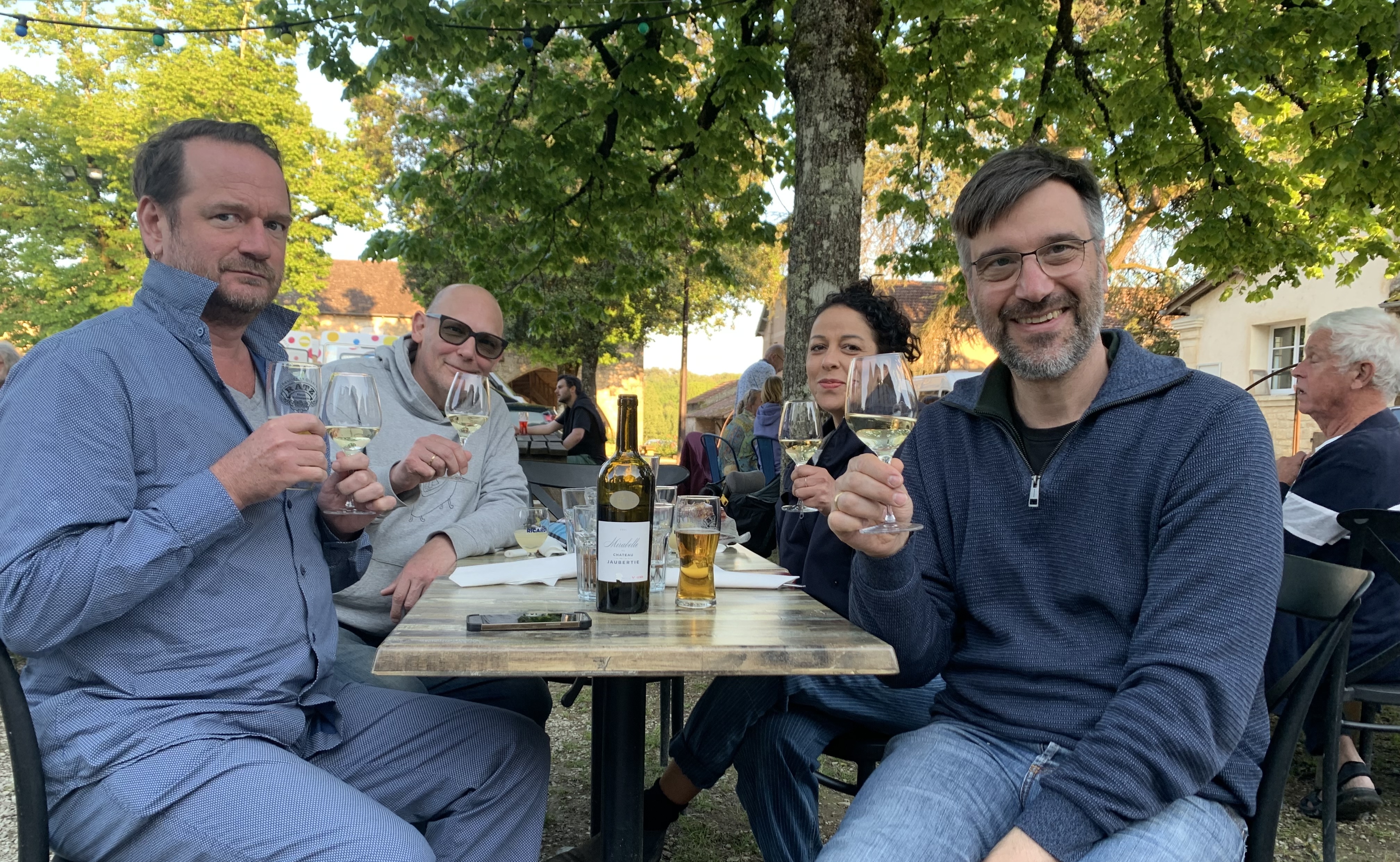
If you’ve ever wondered how details came to be, the short answer is: slowly, from the inside, and one step after the other.
What we did have was deep, practical experience from inside music companies.
Between us, we had spent years working with catalogs, sales data, and royalty statements, sitting on both sides of the table with clients and service providers. Over time, it became obvious that the tools in use no longer matched where the independent music business was heading.
What we didn’t have was a pitch deck, an accelerator, or any ambition to disrupt an industry we were already part of.
I’m Stephan “strom” Rombach, one of the three founders of details. This is my take on how we got here.
Before details Existed
Aki, Tosh, and I met at !K7 in Berlin in the early 2000s.
Tosh had been there before me and was already deep into web technology at a time when most labels were still thinking in terms of physical promotion and printed sales sheets. I joined after studying economics and ended up responsible for manufacturing and distribution, shipping Kruder & Dorfmeister Sessions and DJ-Kicks compilations around the world on CD and vinyl.
Those were intense years. Electronic music was not a niche. It was life. We went to MIDEM, Popkomm, WMC. I learned how the music business worked by becoming part of it.
At some point, my path drifted toward finance and royalties. Counting numbers, reconciling statements, explaining money flows. First at !K7, later for other companies. I did not know it back then, but this quietly became my long-term vocation.
The FileMaker Years
This is where Aki comes in.
Aki was already known as a FileMaker wizard. He had built a distribution system for Kompakt, a guest list tools for the WMF club, and we were working together on what became go_disko, a 360° label management, promotion, booking and distribution tool that was used by a large part of Berlin’s electronic music scene.
We started working together through go_disko, then through other custom systems for companies like Studio Distribution in New York, processing sales statements for more than 80 electronic music labels across Europe.
This is where something clicked for us:
Automated workflows are not about technology. They are about survival for the indie culture.
When royalty data flows automatically and consistently, people can think. When it does not, everything becomes an emergency, all the time.
2008: Leaving FileMaker, Entering the Cloud
In 2008, Aki and I realised that FileMaker had taken go_disko far, but it also concentrated too much responsibility on one person. Moving forward meant building something that could be carried by a team and would allow us to scale.
We teamed up with Tosh and started building what would become details. At the time, we called it disko 3.0.
Cloud software was still a fairly new concept, and the idea of running core systems in a browser was not at all mainstream.
We started with a budget of 50,000 EUR, three clients and two programmers.
The first module we built was booking. Then came label, distribution, and promotion.
Much of that early work was driven by a simple thought: we needed to take care of existing go_disko clients first.
They were used to certain workflows, and those mattered.
Everything existed because someone actually needed it to do their job, often the same people who had trusted us long before details existed.
2009 to 2019
Most company stories skip this part. From my perspective, it’s central to who we are and how we got here:
We grew slowly, learning how to focus, prioritise, and not chase every idea at once.
We made mistakes, organisational, technical, personal, and learned from all of them.
We argued internally about priorities, direction, and resources, and gradually learned how to resolve those arguments without breaking momentum.
And we kept going. Clients stayed. New ones joined. Features matured.
We went from a handful of Berlin labels to dozens, then hundreds of clients across Europe, and later worldwide, from Brazil to Japan.
At no point did we suddenly scale. We evolved. Incrementally.
The COVID Years
Then came COVID.
For us, this period was paradoxical. Entire parts of our client base, especially booking and promotion agencies, had no business and we lost significant turnover almost overnight. At the same time, we probably never worked harder or learned more than during those years.
Behind the scenes, we were building a large white-label royalty solution for one of the world’s top digital distribution companies. While we can’t name them, the scale and complexity pushed us far beyond anything we had previously built. It also proved that our systems, processes, and team could operate reliably at enterprise scale.
Those years forced us to harden our systems, rethink architecture, improve internal processes, and finally confront technical debt we had been carrying for too long.
And it changed the company. We now knew what we were capable of, if only we were pulling in the same direction.
The People Behind details
One thing I want to be clear about is that details was by no means built by the founders alone.
Some of our programmers have been with us for more than two decades. This mutual loyalty came from working together over a long period of time, often across countries and cultures, learning how to deal with misunderstandings, pressure, and change:
We got used to each other. We learned how to communicate, how to disagree without breaking things, and how to keep going even when the work was complex, resources constrained, or required patience .
Our programmers lived through technology shifts, multiple rewrites, and years of overloaded “roadmaps”.
We started by moving away from FileMaker and are now learning how AI can help us work more efficiently, but that will be a blog post of its own.
The same is true for support and project management. We have been incredibly lucky with our client support team. Over the years, they have helped hold this company together by explaining complex data to clients, calming nerves around royalty deadlines and server outages, and fixing things quietly before they became problems.
The support team we have today, and the people who came before them, are the reason details actually works day to day.
I am deeply thankful to everyone who helped details along the way. Not just for the work they did, but for the responsibility, patience, and trust they brought with them.
details Today and Tomorrow
Today, details supports more than 350 active clients worldwide.
We are not a large organisation, but a highly focused one, with a team that has been working together for many years.
What we do today is very hands-on. We help clients migrate catalogs and royalty data, keep day-to-day operational workflows running for labels, distributors, and booking agencies, automate processes, produce royalty statements for those who prefer to outsource that responsibility, and build custom solutions where standard tools fall short.
Most of our work happens behind the scenes, in places where things need to be working reliably long before anyone notices the nuances.
Most priorities come from our clients. The rest are shaped by how the music business evolves, a healthy competition, and my tendency to want everything everywhere at once. Fortunately, experience and the team usually step in before that turns into chaos.
Coming up next will be more AI-supported functions where they genuinely make sense, especially in support, onboarding, and custom reporting.
Not to replace judgement, but to cut repetition and reduce clicks in a system that already carries a lot of complexity.
Also the publishing module, which has been a long time coming, is moving from groundwork into reality.
It builds on years of rights, royalty, and data logic that is already there, but needed the right technology to come together.
Alongside this, we are continuously working to simplify details without losing the flexibility that allows it to adapt to very different clients.
Small teams and large organisations have different needs, and the system has to remain usable for both.
We are not trying to disrupt the music business. We focus on tangible solutions for people who carry responsibility for money, data, and trust.
This is how details keeps moving forward. Quietly, deliberately, and with both feet on the ground.
Moving Forward
We have come a long way, despite plenty of internal and external friction along the way.
What seems to define details is that we move four steps forward for every step back. Sometimes with detours. Often slower than planned. But consistently forward.
That is probably the most honest description of how independent companies actually survive.
If parts of this sound familiar, feel free to get in touch!
strom@details.eu
Read more blog posts

Making Money as a Truly Independent Label
Indie record labels undoubtedly have a reputation for being cool and edgy places to work. Only putting out underground music and dedicating their work life to unearthing quirky music that only hits niches at best.
E-Invoicing in details: What You Need To Know
If you deal with invoices in the music business, you’ve probably heard the term e-invoicing by now. Across Europe, structured electronic invoices are becoming mandatory step by step, and by 2026 they will be the standard for most B2B transactions. details helps you meet these requirements without changing how you create or manage your invoices day to day.

Royalty Software: Find the right Solution for You
A reliable royalty software is the basis of most music industry companies. Record labels, distributors and publishing houses alike need software that helps them convert the income from physical sales and streams into royalty statements for the artists.